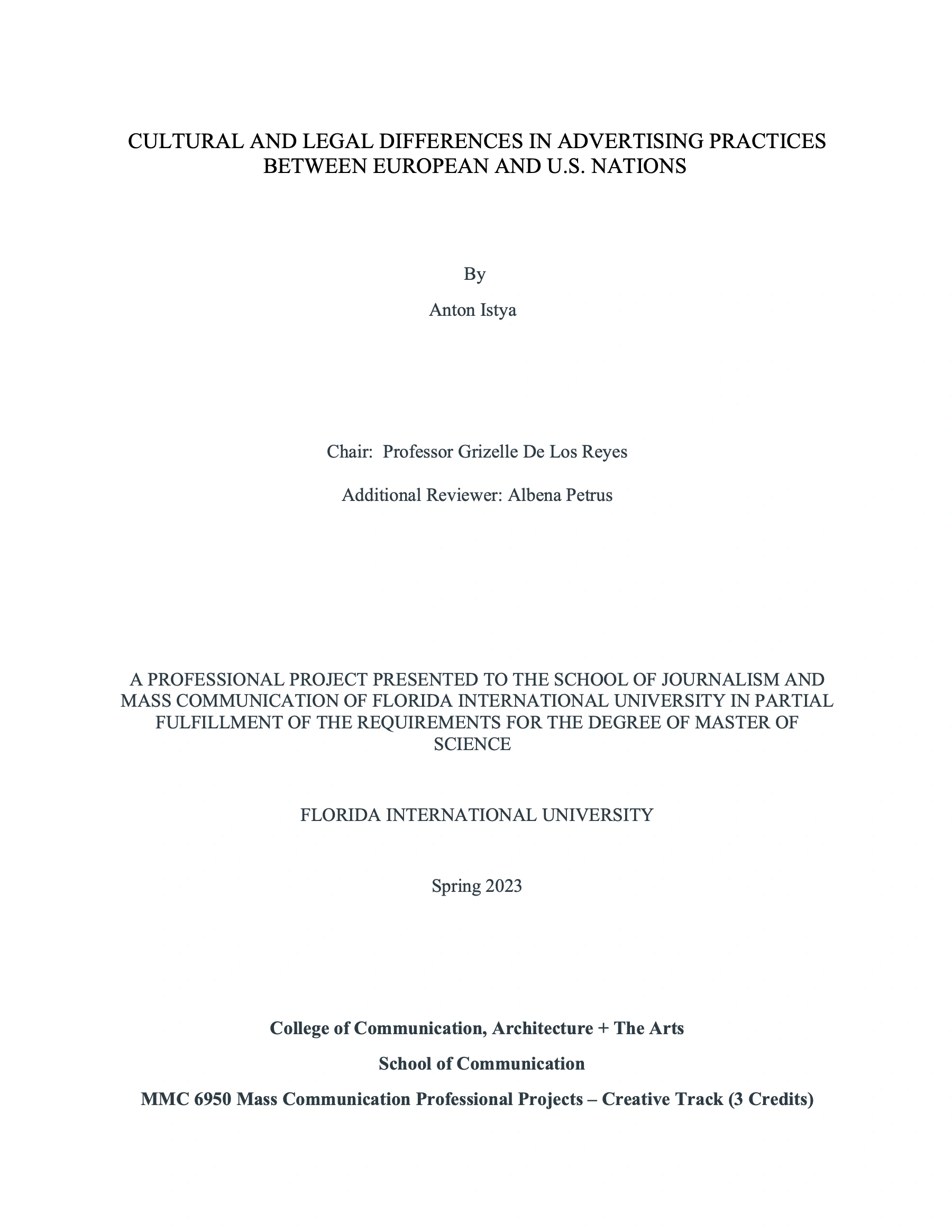
Comparative advertising, brand rivalry and consumer trust. An exploration of what happens when the same competitive message meets different cultural expectations.
Research & writing Anton Istya
Academic guidance Professor Grizelle De Los Reyes, Chair Albena Petrus, Additional Reviewer
Program MS, Global Strategic Communications Florida International University
The question
Competition is universal. Its meaning is contextual.
Why can an advertisement that feels witty and competitive in one setting feel abrasive in another? This project began with a personal observation: direct comparisons between brands in American advertising felt different from the advertising I had encountered in Europe.
That observation became a question about audience interpretation. How do cultural context, ethical expectations, awareness of advertising rules and creative strategies shape people’s responses to comparative advertising?
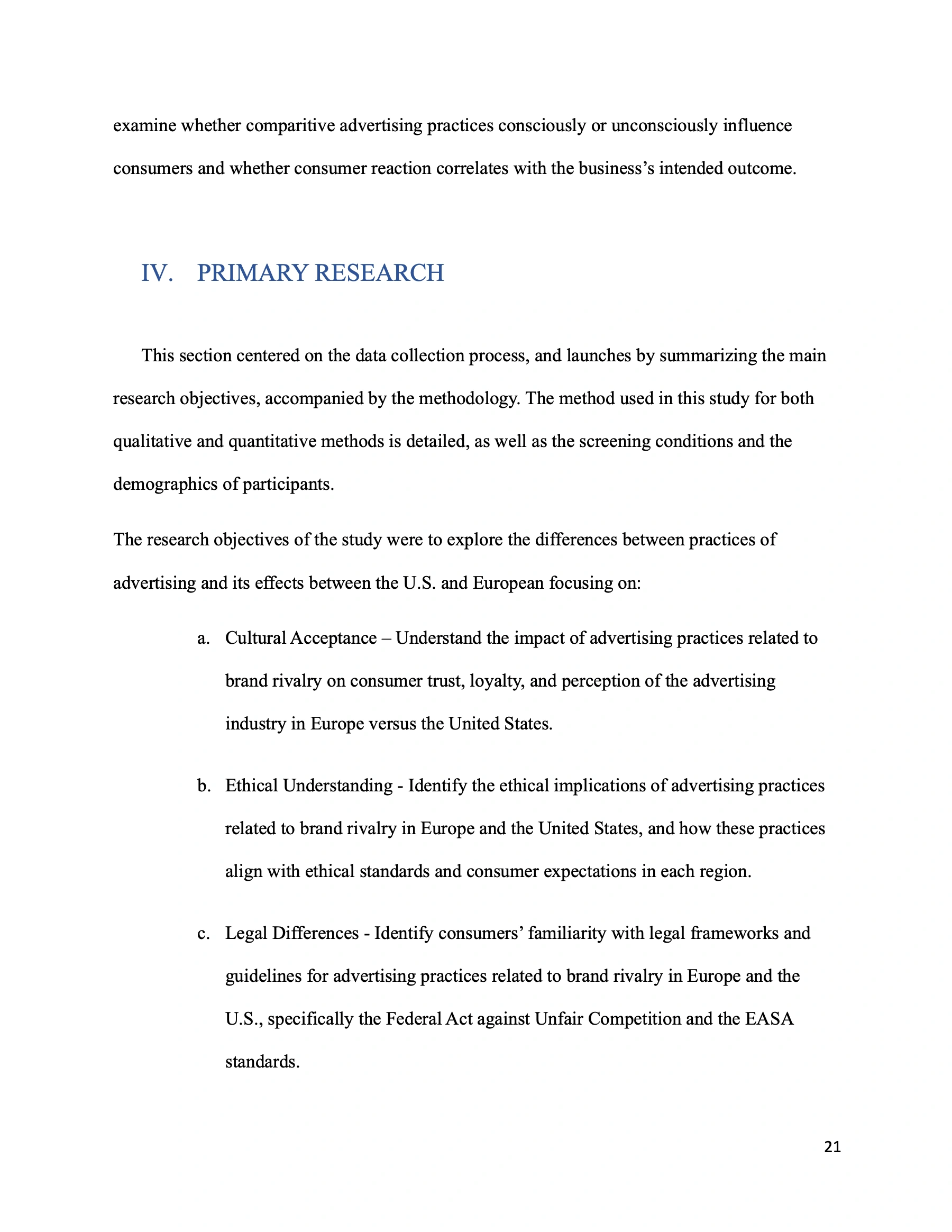
The intended focus was the United States, France, Germany and the United Kingdom. Developed within FIU’s Mass Communication Professional Projects — Creative Track, the work brought together a literature review, qualitative interviews and a consumer survey.
Final manuscript, pages 1, 3–6 and 21–23.
Original manuscript · title page Open original ↗
Building the study
One question. Two kinds of evidence.
20Interviews reported in the final manuscript
111Survey respondents
59Pages in the final manuscript
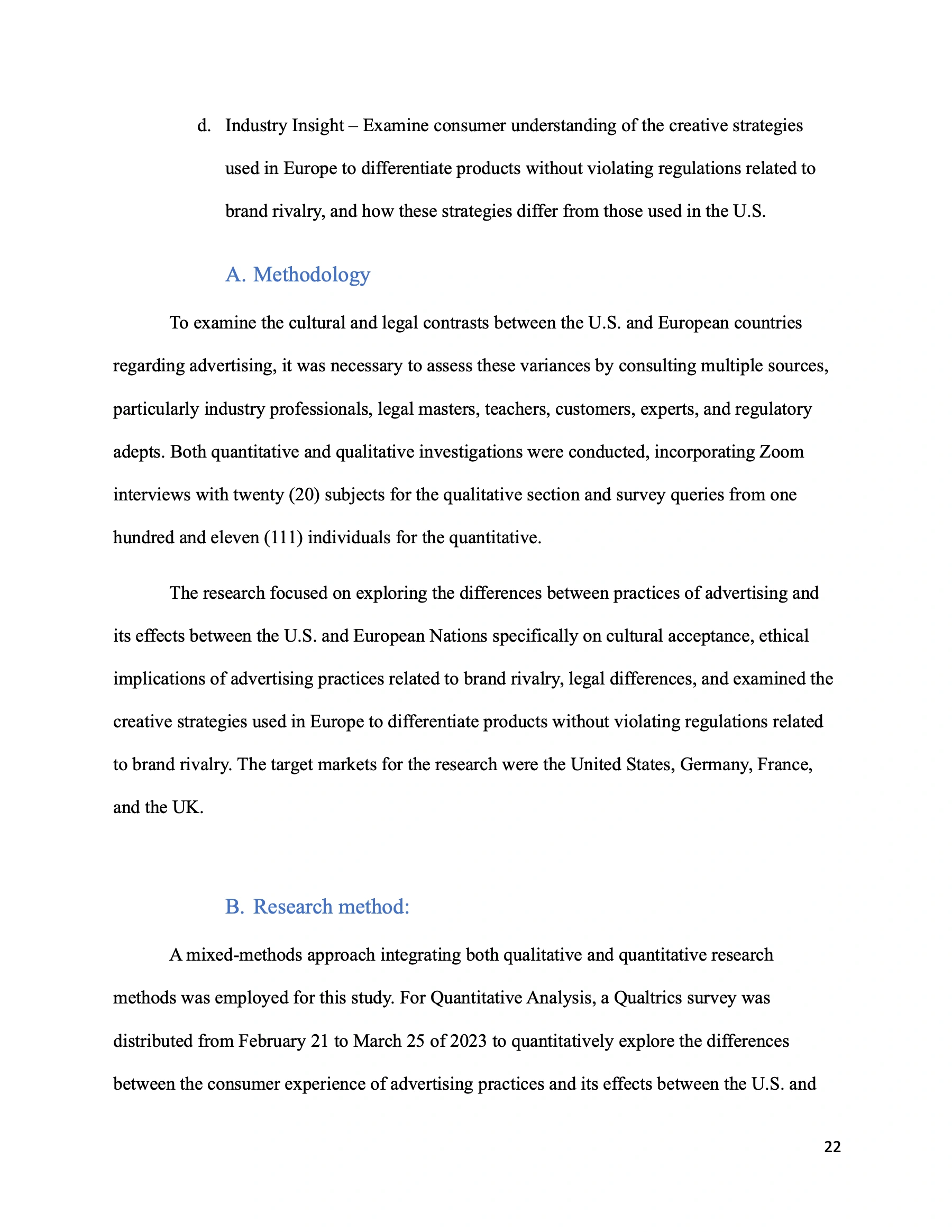
Fieldwork: February 21–March 25, 2023
Build the context
The literature review examined regulation, cultural interpretations, persuasion theory and the potential advantages and disadvantages of comparative advertising. Historical campaign examples helped frame the inquiry; those advertisements were references being studied, not campaign work created for this project.
Listen & measure
A Qualtrics survey explored advertising exposure, product comparisons, trust and hypothetical reactions to brand attacks. Telephone and Zoom interviews, using a consistent moderator guide, added qualitative perspectives. The interviews used convenience sampling.
Connect the evidence
The survey recorded the distribution of answers within the sample. The interviews informed the manuscript’s discussion of tone, context and cultural expectations. Together, they supported an exploratory interpretation of the communication problem.
Final manuscript, pages 6–23. Aggregate survey report: 30 question outputs.
Final manuscript · page 21 Open original ↗Final manuscript · page 22 Open original ↗
What the responses revealed
A claim can invite scrutiny. Not just a change of mind.
The figures below describe the pooled sample of 111 respondents. They are self-reported answers to survey questions, not measured purchasing behavior or campaign results.
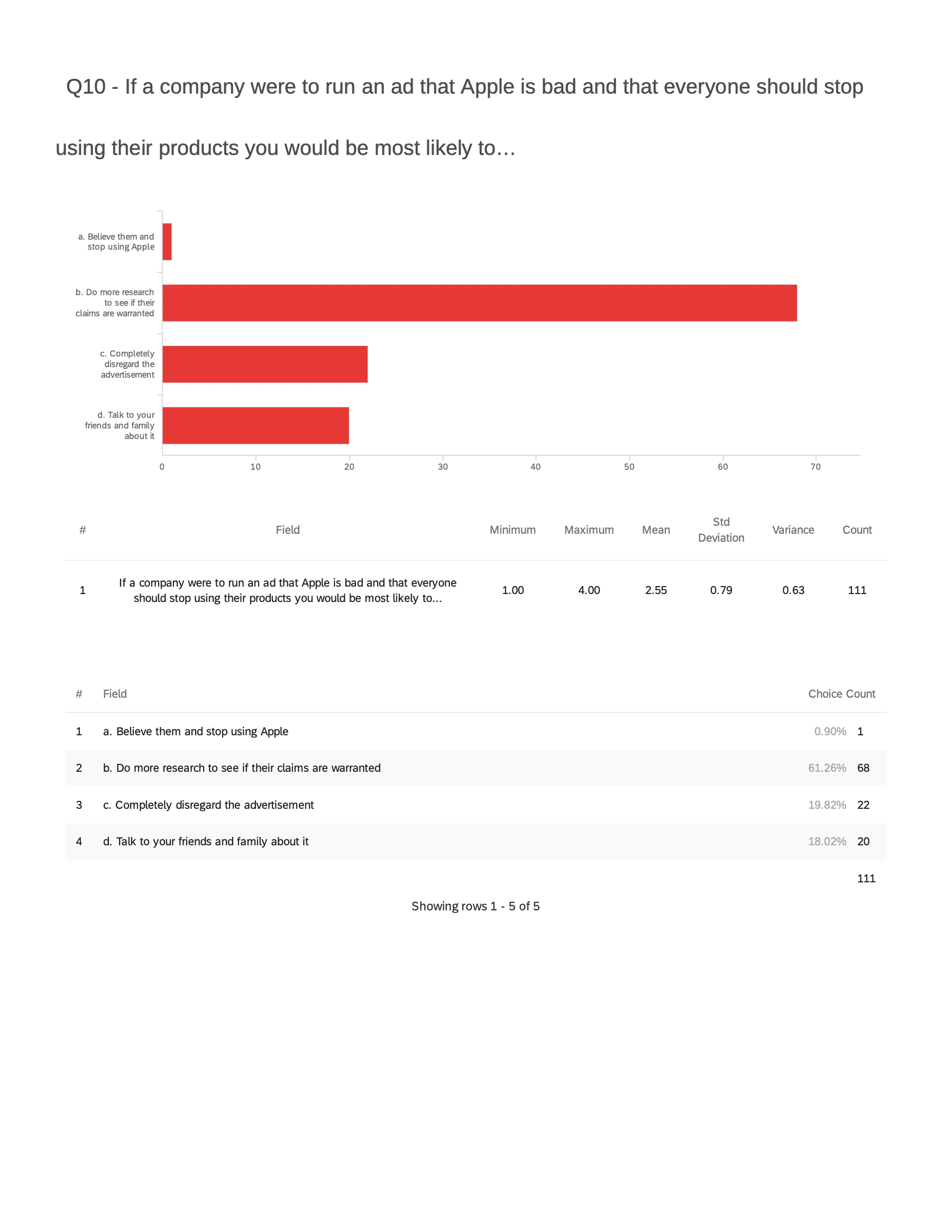
68 / 111 61.26%
Check the claim.
In a hypothetical advertisement criticizing Apple, 68 respondents said they would research whether the claims were warranted. Only 1 selected the option to believe the advertisement and stop using Apple.
Within this scenario, a negative claim most often prompted further investigation. The distinction between attracting attention and persuading someone to abandon a brand is central to interpreting the result.
Aggregate survey report · Q10, page 14.
Original survey output · Q10 Open original ↗
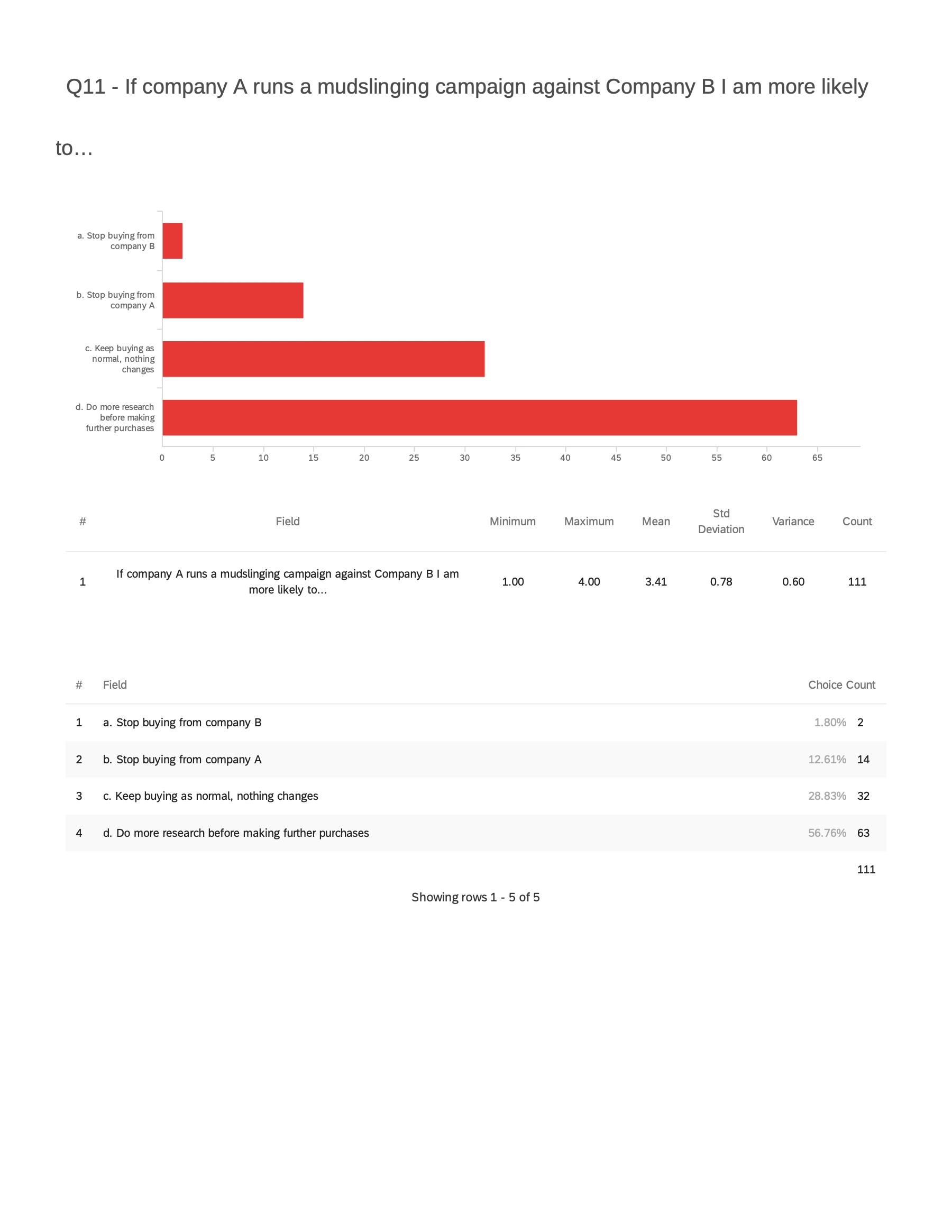
63 / 111 56.76%
A second scenario. A similar response.
When company A attacked company B, 63 respondents chose further research before purchasing. Another 32 said their buying would not change; 14 would stop buying from the attacking company; 2 would stop buying from the target.
The attacker could also lose credibility. A forceful comparison may generate scrutiny of the company making it, as well as the company being criticized.
Aggregate survey report · Q11, page 15. Interpretation applies to this hypothetical scenario.
Original survey output · Q11 Open original ↗
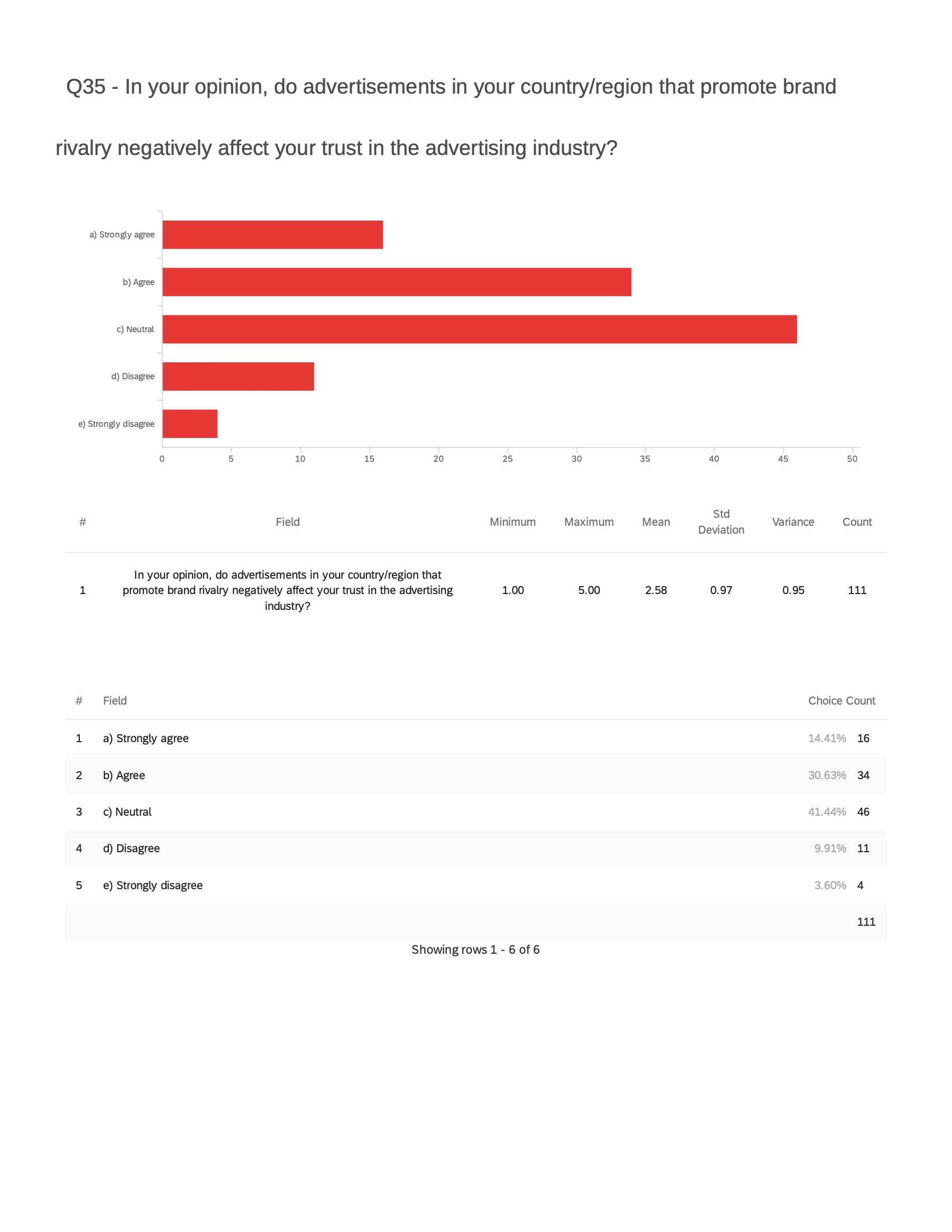
50 / 46 / 15
Trust was not a yes-or-no response.
Asked whether rivalry-based advertising negatively affected trust in the advertising industry, 50 respondents agreed or strongly agreed, 46 were neutral and 15 disagreed or strongly disagreed.
The combined agreement group was 45.05%. Neutral, at 41.44%, was the largest single response category. These distinctions matter: neither figure represents a majority of the sample.
Aggregate survey report · Q35, page 29. Agreement and disagreement groups combine the original response counts.
Original survey output · Q35 Open original ↗
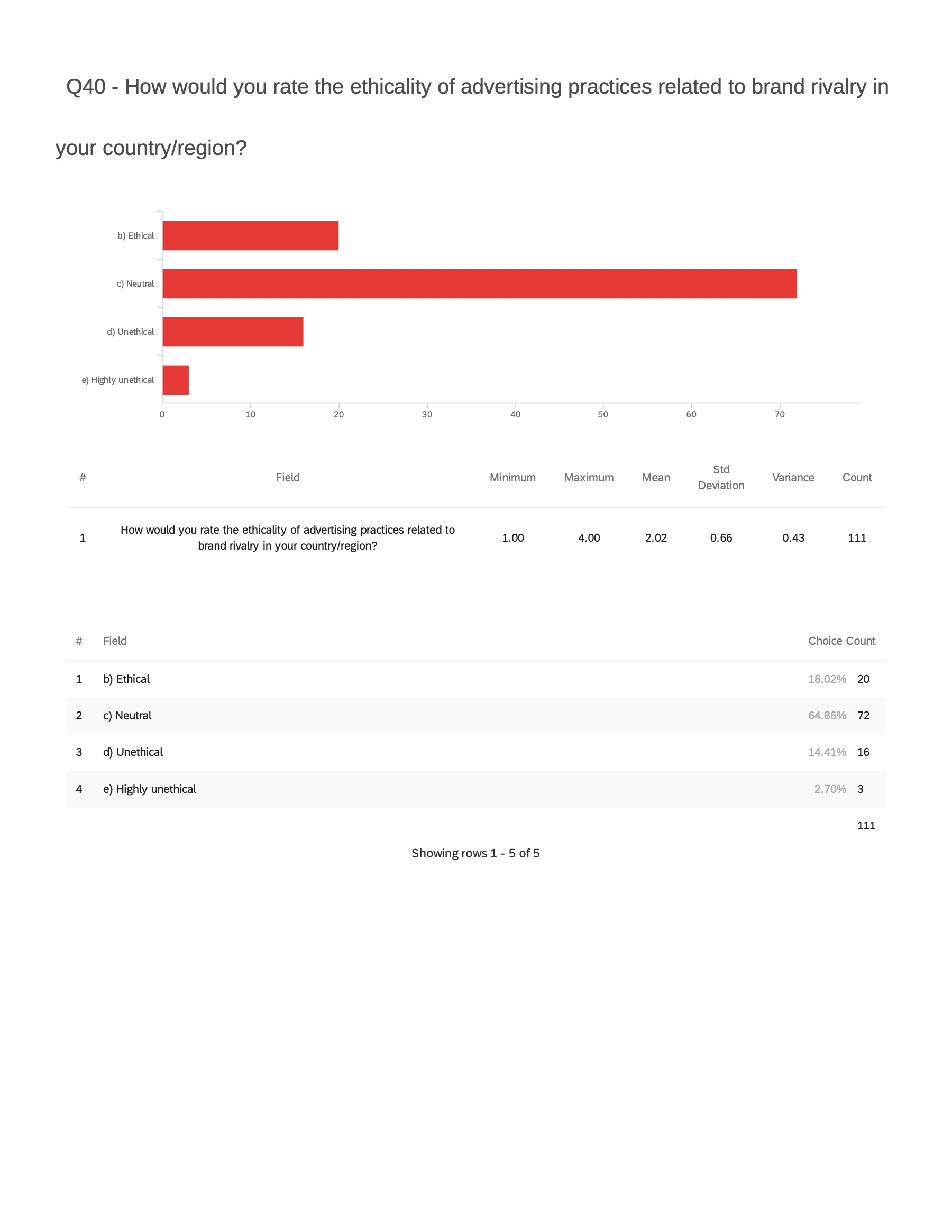
72 / 111 64.86%
Ethicality drew a neutral majority.
When asked to rate the ethicality of brand-rivalry advertising in their country or region, 72 respondents selected neutral.
Read alongside the trust question, this shows why the study cannot be reduced to universal approval or rejection. The particular judgment being requested changes the response.
Aggregate survey report · Q40, page 30.
Original survey output · Q40 Open original ↗
Cultural context & creative strategy
Read the room. Then write the message.
Tone changes the reading
The manuscript’s qualitative discussion explores tolerance for direct rivalry, humor, restraint and the possibility that attacking a competitor damages the attacking brand’s own credibility. These are themes from the study’s interpretation, not established traits of every American or European consumer.
Its practical recommendation is to consider cultural expectations and relevant local rules when developing comparative communication.
Perception carries uncertainty
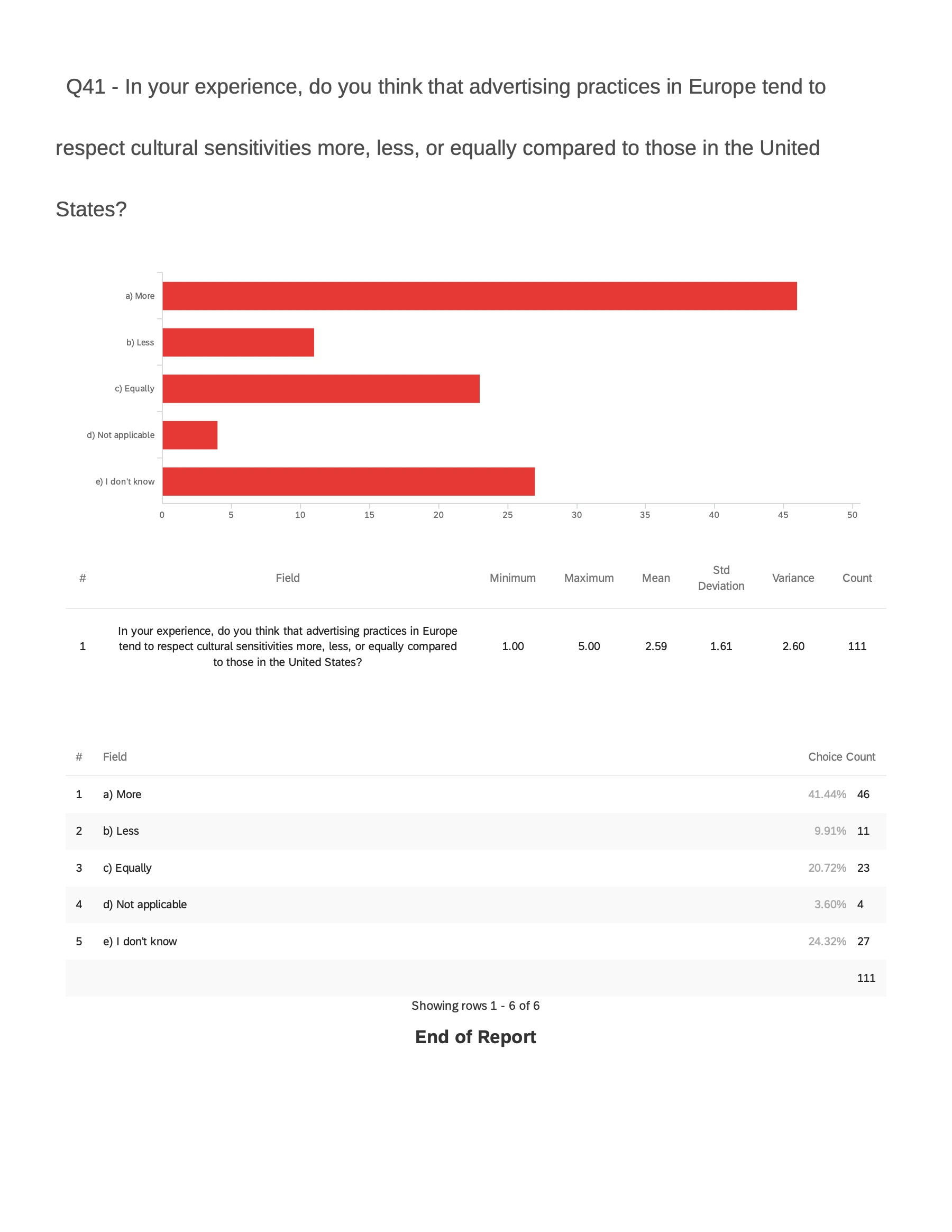
Asked whether European advertising respected cultural sensitivities more than U.S. advertising, 46 respondents selected “more,” 23 “equally,” 11 “less,” 27 “I don’t know” and 4 “not applicable.”
The leading answer was a plurality, not a majority. It describes this sample’s perceptions; it does not rank the regions’ actual ethical standards.
Final manuscript, pages 27–40; aggregate survey report, Q41, page 31.
View the original cultural-sensitivity responsesOriginal survey output · Q41 Open original ↗
Reading the findings responsibly
Exploratory work. Defined boundaries.
The sample
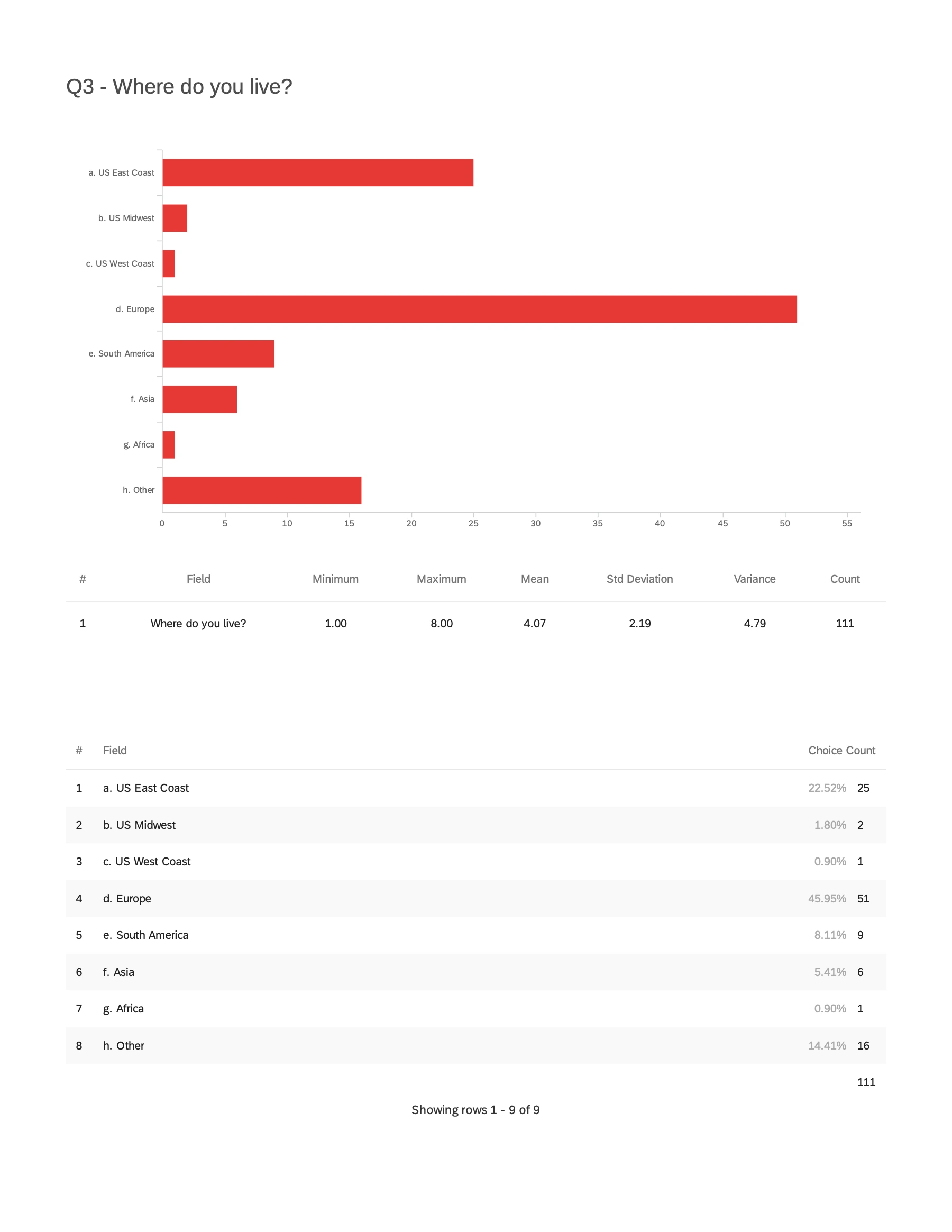
Interviews used convenience sampling. The survey’s pooled sample included 51 respondents from Europe, 28 from the United States and 32 from other regions. It is not presented as a representative national sample.
The comparisons
The preserved aggregate report does not provide country-by-country statistical tests. These results cannot establish a statistical difference between U.S. and European audiences.
The outcomes
Answers concern attitudes and hypothetical choices. The project did not measure sales, campaign lift or causal effects. Its legal discussion belongs to the 2023 academic context.
Final manuscript, pages 23 and 40; aggregate survey report, Q3, page 2.
View the original sample geographyOriginal survey output · Q3 Open original ↗
The work produced
From an observation to a research foundation.
The final body of work includes a 59-page manuscript, a 32-page aggregate survey report, a research brief and proposal, and questionnaire and interview-guide drafts.
The process connects an initial observation to research objectives, questions, mixed methods, interpretation and a practical communication problem. It provides a foundation for asking better questions about a campaign’s tone and audience.
The original pages shown here are selected exports of those deliverables. Participant-level material is kept private. Brand names and historical advertisements appear as research references or survey scenarios.
Original manuscript title
Cultural and Legal Differences in Advertising Practices Between European and U.S. Nations
Anton Istya · Florida International University · Spring 2023
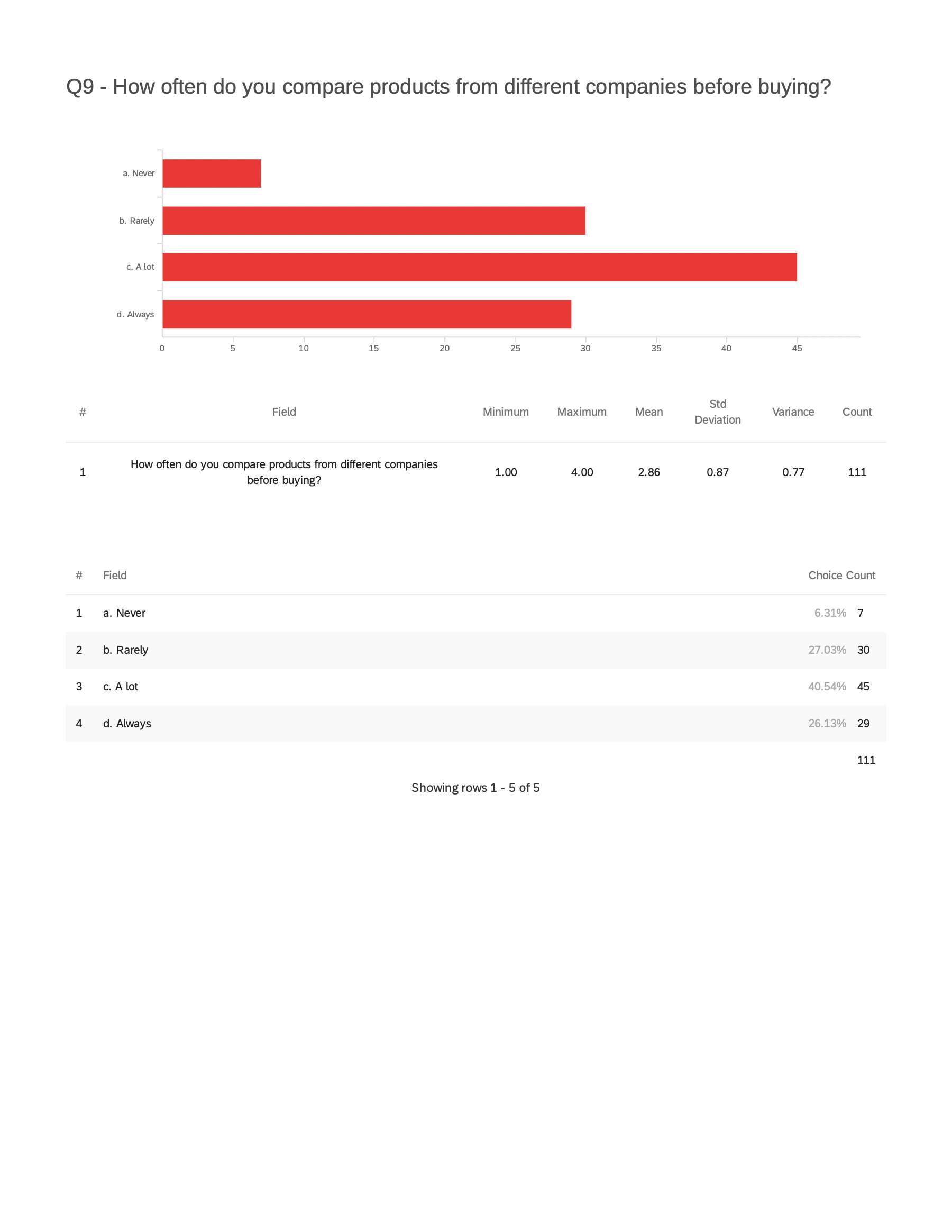
View the original product-comparison questionOriginal survey output · Q9 Open original ↗
Development / The thinking in motion
From a broad question to a defined study
The project began with an observation about the different ways brands criticize and compare themselves with competitors. The first proposal framed that question broadly across Europe and the United States. Developing the research meant turning the observation into four areas of inquiry: cultural acceptance, ethical expectations, awareness of advertising rules and creative approaches to differentiation.
Academic review called for a tighter scope and clearer links between the literature, primary research and recommendations. The revisions made the geographic focus explicit: the United States, France, Germany and the United Kingdom. The legal objective also became more closely tied to what the primary research could ask consumers—their familiarity with the rules surrounding brand rivalry.
The writing then changed to make the reasoning easier to follow. The abstract was expanded to describe the methods, reported findings and scope. Findings were brought together with explanations and selected evidence, while the larger collection of survey outputs moved to an appendix. The discussion made its connections to the literature more explicit, including an area where survey responses complicated the broader interpretation.
A dedicated limitations section defined what the project covered and what remained open. The resulting manuscript presents an exploratory study with visible methods, supporting material and boundaries. Its development was as much about communicating the evidence clearly as assembling it.
Anton Istya — research and writing within his FIU master's project. This development account does not establish representative sampling or independently verify the interview total reported in the final manuscript.